




2020 Annual report
The Academy’s responses to COVID-19 are among the many achievements highlighted in the report.

The Australian Academy of Science 2020 Annual Report covers 1 January to 31 December 2020.
The Academy’s responses to COVID-19 are among the many achievements highlighted in the report.
Major achievements included providing leadership and support for the Rapid Research Information Forum (RRIF) to produce expert reports; collaborating with government departments to communicate pandemic-related information; creating an online database to enable public access to more than 1800 experts; supporting teachers and parents with emergency remote teaching; and initiating Global Science TV in partnership with the International Science Council.
2020 highlights
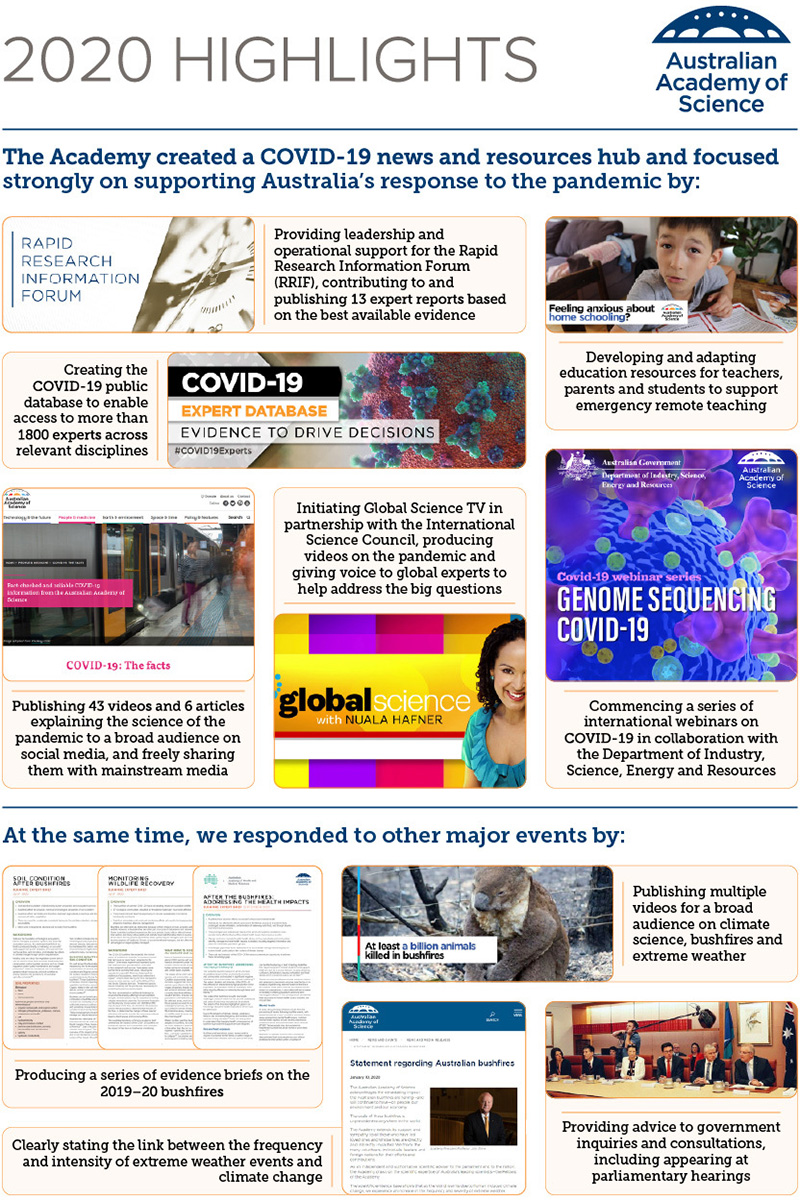
The Academy created a COVID-19 news and resources hub and focused strongly on supporting Australia’s response to the pandemic by:
- providing leadership and operational support for the Rapid Research Information Forum (RRIF), contributing to and publishing 13 expert reports based on the best available evidence
- creating the COVID-19 public database to enable access to more than 1,800 experts across relevant disciplines
- developing and adapting education resources for teachers, parents and students to support emergency remote teaching
- publishing 43 videos and 6 articles explaining the science of the pandemic to a broad audience on social media, and freely sharing them with mainstream media
- initiating Global Science TV in partnership with the International Science Council, producing videos on the pandemic and giving voice to global experts to help address the big questions
- commencing a series of international webinars on COVID-19 in collaboration with the Department of Industry, Science, Energy and Resources
- publishing 43 videos and 6 articles explaining the science of the pandemic to a broad audience on social media, and freely sharing them with mainstream media.
At the same time, we responded to other major events by:
- producing a series of evidence briefs on the 2019–20 bushfires
- clearly stating the link between the frequency and intensity of extreme weather events and climate change
- publishing multiple videos for a broad audience on climate science, bushfires and extreme weather
- providing advice to government inquiries and consultations, including appearing at parliamentary hearings.
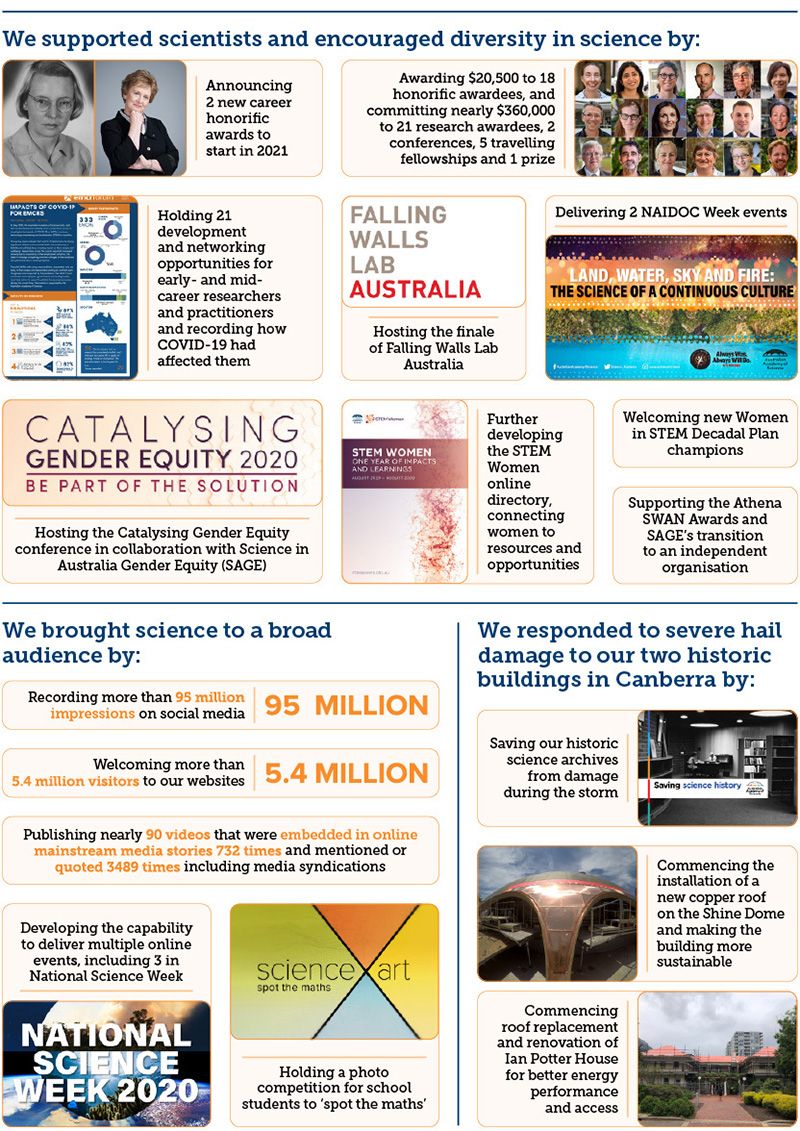
We supported scientists and encouraged diversity in science by:
- announcing 2 new career honorific awards to start in 2021
- awarding $20,500 to 18 honorific awardees, and committing nearly $360,000 to 21 research awardees, 2 conferences, 5 travelling fellowships and 1 prize
- holding 21 development and networking opportunities for early- and mid-career researchers and practitioners and recording how COVID-19 had affected them
- hosting the finale of Falling Walls Lab Australia
- delivering 2 NAIDOC Week events
- hosting the Catalysing Gender Equity conference in collaboration with Science in Gender Equity (SAGE)
- further developing the STEM Women online directory, connecting women to resources and opportunities
- welcoming new Women in STEM Decadal Plan champions
- supporting the Athena SWAN Awards and SAGE's transition to an independent organisation.
We brought science to a broad audience by:
- recording more than 95 million impressions on social media
- welcoming more than 5.4 million visitors to our websites
- publishing nearly 90 videos that were embedded in online mainstream media stories 732 times and mentioned or quoted 3489 times including media syndications
- developing the capability to deliver multiple online events, including 3 in National Science Week
- holding a photo competition for school students to ‘spot the maths’.
We responded to severe hail damage to our two historic buildings in Canberra by:
- saving our historic science archives from damage during the storm
- commencing the installation of a new copper roof on the Shine Dome and making the building more sustainable
- commencing roof replacement and renovation of Ian Potter House for better energy performance and access.