




Christopher Heyde Medal
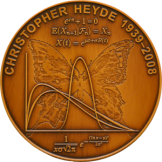

Award highlights
- The award recognises outstanding research in the mathematical sciences by researchers up to 10 years post PhD in the calendar year of nomination. It is offered in different fields of mathematics on a rotating basis.
- The 2027 medal is for pure mathematics, applied, computational and financial mathematics.
- This award honours the contributions to mathematics by the late Professor Christopher Charles Heyde AM FAA FASSA.
In recognition of Professor Heyde’s broad interests in the mathematical sciences the award is offered in one of the following fields on a rotating basis:
- 2027 - Pure mathematics, applied, computational and financial mathematics
- 2028 - Probability theory, statistical methodology and their applications
- 2029 - Pure mathematics, applied, computational and financial mathematics
The award’s purpose is to recognise outstanding research in the mathematical sciences by researchers up to 10 years post PhD in the calendar year of nomination, except in the case of significant interruptions to a research career. The award may be made annually, with a prize of $6,000, and is restricted to candidates who are normally resident in Australia.
This award is open to nominations for candidates from all genders. The Australian Academy of Science encourages nominations of female candidates and of candidates from a broad geographical distribution.
Candidates may be put forward for more than one award. If a proposed candidate is already the recipient of an Academy early-career honorific award, they will not be eligible for nomination for another early-career or mid-career honorific award. A mid-career honorific award recipient will also not be eligible for nomination for another mid-career honorific award. Fellows of the Academy are ineligible to be nominated for early and mid-career awards.
Key dates
Below are the key dates for the nomination process. While we aim to keep to this schedule, some dates may change depending on circumstances.
GUIDELINES
The following guidelines and FAQs provide important information about eligibility, submission requirements, and assessment processes. Please review them carefully before submitting a nomination.
How to nominate a scientist for the Academy’s honorific awards
The following guidelines contain detailed information for nominators.
These guidelines contain information for honorific award nominators.
The following guidelines contain information for honorific award referees.
These guidelines contain information for honorific award referees.
See below for specific relevant conferral dates for the current award round.
This document contains specific PhD conferral dates for early and mid-career honorific awards in the current award round.
Please submit your nominations using the Nominate button found on the top right of this webpage when nominations are open.
Please note the Academy uses a nomination platform that is external to the main Academy site. Nominators will be required to create an account on the platform. Even if you are familiar with the nomination process, please allow extra time to familiarise yourself with the platform.
Early-career, mid-career and career medals
Can I nominate myself?
- No – you must be nominated by someone else. Self-nominations are not accepted.
Can I submit a nomination on behalf of someone else?
- Yes – you can submit a nomination on behalf of someone else if you are not the nominator. An example would be a university grants office or personal/executive assistant completing the online nomination form on behalf of a nominator. Once the form is submitted, the nominator will be sent an email confirming that the nomination has been completed. If a nominee submits a nomination for themselves on behalf of a nominator it will not be considered a self-nomination.
Residency requirements
- Winners of all awards except the Haddon Forrester King Medal should be mainly resident in Australia and/or have a substantive position in Australia at the time of the nomination deadline. Unless explicitly stated in the awarding conditions, the research being put forward for the award should have been undertaken mainly in Australia. Some awards have more specific conditions that the relevant selection committee must apply and nominators are advised to read the conditions associated with each award very carefully.
Honorific career eligibility (more specific details found in the honorific awards nominator guidelines and the honorific award post PhD eligibility guidelines)
- Career eligibility is calculated by calendar year.
- Early career awards are open to researchers up to 10 years post-PhD.*
- Mid-career awards are open to researchers between eight and 15 years post-PhD.*
- Please note that the Awards Committee may consider nominees with post PhD dates outside of these ranges if a career exemption request is being submitted with the nomination, further guidelines on career exemption requests can be found in the nomination guidelines.
- See the post-PhD eligibility guidelines document for relevant conferral dates.
- * or equivalent first higher degree e.g. D.Phil., D.Psych., D.Sc.
Academy fellowship requirements in award nominations
- Fellows and non-Fellows of the Academy can provide nominations for either Fellows or non-Fellows for all awards.
Women only awards
- The Dorothy Hill, Nancy Millis and Ruby Payne-Scott Medals are for women only. These medals are open to nominees who self-identify as a woman in the award nomination form. The Academy does not require any statement beyond a nominee’s self-identification in the nomination form.
- This practice is consistent with the Sex Discrimination Act 1984, which has recognised the non-binary nature of gender identity since 2013, and gives effect to Australia’s international human rights obligations. The Academy remains committed to the fundamental human rights principles of equality, freedom from discrimination and harassment, and privacy, as well as the prevention of discrimination on the basis of sex and gender identity.
PREVIOUS AWARDEES
Dr Belinda Phipson, Walter and Eliza Hall Institute of Medical Research (WEHI)
Medical research is becoming increasingly quantitative as new technologies emerge that can capture thousands of measurements at increasingly higher resolution. Over the last decade, the field has progressed from profiling genomic information of whole samples to profiling individual cells. In order to translate these complex large datasets into medical discoveries, robust statistical methods and software are needed.
Dr Belinda Phipson is an internationally recognised early-career statistician working in bioinformatics and medical research. She has consistently leveraged advanced statistical ideas to develop novel methods for the analysis of genomic data. She has made these methods available to the global research community through the development of high-quality open-source software. In collaborations, she has used these tools to understand biological processes and to make discoveries of medical significance in cancer therapy, kidney development and disease, heart development, and stem cell biology.
Dr Stephen Muirhead, Monash University
Dr Stephen Muirhead is an outstanding researcher in probability theory who has made important contributions to percolation theory (the study of how global connectivity in a material or network arises out of microscopic properties), stochastic geometry, and random field theory. His work has resolved long-standing conjectures in the physics literature and pioneered a set of new techniques which are having a tremendous impact on the development of these fields.
Associate Professor Anita Liebenau, University of New South Wales
Associate Professor Anita Liebenau is recognised internationally as a leading expert in extremal and probabilistic combinatorics. She has worked on enumeration problems of large discrete structures such as regular graphs, problems in Ramsey theory and combinatorial games played on graphs. Among her many achievements, she developed a breakthrough method for enumerating regular graphs, leading to the first progress since 1989. She has also proved important results on thresholds for games on graphs, and has made major contributions towards resolving the Erdős–Hajnal conjecture.
Professor Serena Dipierro, University of Western Australia
After moving to Australia, first to the University of Melbourne and then to the University of Western Australia, Professor Serena Dipierro has significantly contributed to several fields in mathematical analysis, partial differential equations, nonlocal equations and free boundary problems. A characteristic treat in Professor Dipierro’s research consists in the fine analysis of the special patterns created by the interplay between nonlinear and nonlocal structures, also in light of motivations coming from biology and physics. Her works established the regularity properties and the geometric features of the interfaces arising from phase transitions, with special attention to the brand-new, and often very surprising, phenomena produced by far-away particle interactions and by the energy contributions ‘coming from infinity’. Her findings comprise the solution to challenging problems and the opening of brand-new lines of research, which will remain as a solid source of inspiration for future investigations on a number of emerging topics.
Dr Christopher Lustri, University of Sydney
It is often impossible to write down exact mathematical expressions to perfectly describe extremely complex natural systems such as the collective behaviour of a colony of ants, gravitational waves generated by orbiting black holes, or the flow of air over an aircraft’s wing. Asymptotic approximation theory can accurately predict how these complicated systems will change and evolve, even when they are far too complicated to solve exactly. Dr Christopher Lustri is an expert in developing new asymptotic approximation methods that capture important behaviour which is hidden from widely-used classical approximation techniques. Using these new methods, he has resolved open mathematical problems arising in practical scientific settings, such as explaining the shape of waves that form behind submerged obstacles, or the energy loss experienced by pulses in laboratory particle chains. He discovered that complex discrete systems contain important ‘tipping points’ that were previously unknown. If subtle changes are made to how the system is set up when the system is near one of these points, its behaviour can change dramatically. Dr Lustri’s methods make it possible to accurately capture how systems behave when they are near these tipping points.
Dr Valentina Wheeler, University of Wollongong
Dr Valentina Wheeler is a geometric analyst who has made major contributions to the field of elliptic and parabolic partial differential equations. In particular, her work focusses on geometric flows called curvature flows. These describe the movement and/or evolution of a curve or surface through space and time via continuous geometric deformation determined by curvature. Valentina’s contributions include resolutions of open conjectures regarding partition problems and existence of minimal hypersurfaces; completely novel types of singularities for curvature flows; the first global analysis of the Helfrich functional; and a powerful new Harnack convergence argument for fully nonlinear curvature flows with non-smooth speed. Her results include direct applications to real-world problems including modelling for the blood disease spherocytosis, behaviour of other biological membranes, and motion and evolution of merging fire fronts.
Dr Francis Hui, Australian National University
Dr Francis Hui’s research focuses on the development of innovative, fast approaches for the statistical analysis of big data, particularly when many correlated variables are collected in space and/or time to produce richly correlated data. He has made substantial contributions to the literature on efficient approximate methods for fitting multi-level models, techniques for data visualisation of many variables and scalable tools for flexibly fitting non-linear models and for selecting which predictors to include in complex correlated data settings. Dr Hui works at the interface between methodological and applied statistics, ensuring that his research has an immediate and substantial impact on the wider scientific community. His research has been particularly impactful in ecology, where his methods and software are applied by practitioners to project spatio-temporal change of species assemblages under climate change scenarios and for enhancing the understanding of terrestrial and marine ecosystems both across Australia and internationally.
Dr Kevin Coulembier, University of Sydney
Dr Coulembier’s research is in the field of mathematics known as representation theory, which studies how abstract algebraic structures are manifested as the solutions to concrete systems of linear equations. This field retains a strong connection to its origin as the study of geometric symmetry both discrete and continuous, but more recently has developed far beyond this in tackling curved and infinite-dimensional spaces and arbitrary number systems. One of Dr Coulembier’s most important discoveries was of a way to detect the presence of the classical type of symmetry known as an affine group scheme in a more exotic setting known as a tensor category; this problem had defied the efforts of some of the world’s top mathematicians for almost thirty years. He has also solved several other important problems in infinite-dimensional representation theory, and has discovered new unified proofs of major theorems concerning the invariants of groups and supergroups.
Dr Vera Roshchina, UNSW Sydney
Dr Roshchina is an exceptional mathematician and emerging international leader in the field of non-smooth optimization. Her main interest lies in finite dimensional geometry, more specifically, open problems that originate from continuous optimization and related fields. Some significant problems of this kind are in the geometry of polytopes, for example the polynomial Hirsch and Durer conjectures, critical point problems (Fekete problem, Sendov's conjecture) and convex variational problems, such as asymmetric Newton's aerodynamic problem. Resolution of these challenges is critical for making progress with numerous applications, from engineering and economics to medical research and data analytics.
Dr Jennifer Flegg, University of Melbourne
Drug resistance is a growing issue for malaria control. Dr Jennifer Flegg develops predictive statistical models in space and time for the level of drug resistance. These predictive models fill in the gaps where no information is available on drug resistance and have been used by health agencies to develop new polices about where and when certain drugs are appropriate to use.
Dr Flegg also develops mathematical models to describe and help understand the ways that cells and chemicals interact with each other during the healing of a skin wound. By building models that simulate the successful healing of a wound, she provides biological insight into the underlying healing mechanisms. In the case when a wound would not heal without intervention, she uses her models to predict how treatments can help the wound to heal.
Professor Ryan Loxton, Curtin University
Professor Ryan Loxton is pioneering new mathematical algorithms for optimising complex systems in a wide range of applications such as mining, robotics, agriculture, and industrial process control. Such systems are typically of enormous scale in practice, with hundreds of thousands of inter-related variables and constraints, multiple conflicting objectives, and numerous candidate solutions that can easily exceed the total number of atoms in the solar system, overwhelming even the fastest computers. Professor Loxton’s research provides new mathematical advances for overcoming this complexity and deriving fast algorithms for real-world use. He has collaborated with many companies with his work leading to innovative mathematical techniques for solving real-world problems such as providing algorithms for an award-winning Quantum technology platform that optimises the sequence and timing of maintenance activities in mine plant shutdowns.
Professor Geordie Williamson FAA FRS, University of Sydney
Professor Williamson is a world leader in the field of geometric representation theory. Among his many breakthrough contributions are his proof, together with Ben Elias, of Soergel's conjecture—resulting in a proof of the Kazhdan-Lusztig positivity conjecture from 1979; his entirely unexpected discovery of counter-examples to the Lusztig and James conjectures; and his new algebraic proof of the Jantzen conjectures.
Dr Zdravko Botev, University of New South Wales Sydney
Dr Zdravko Botev has developed innovative methodologies that aim to understand the probability structures underlying the occurrence of high-cost, hard-to-predict events. The novel rare-event simulation algorithms he has derived have not only advanced the fields of computational statistics and applied probability, but have been applied in multiple domains, including communication and computer network design, digital watermarking, safety assessment of debris collision in space and chemical geology. His well-cited research further demonstrates the significant influence of his work in his field of applied probability, as well as applications in many areas. His work has also had significant influence in the field of computational statistics, where his methods have been used in innovative ways to develop very fast algorithms for fitting flexible, smooth models to noisy data.
Dr Luke Bennetts, University of Adelaide
Dr Bennetts is an applied mathematician who models how waves of various kinds, e.g. acoustic waves, electromagnetic waves and waves at the surface of the ocean, are affected by solitary objects or assemblages of objects in their path. A major focus is on how ocean waves interact with ice floes in the polar seas, as this phenomenon appears to be a key contributor to the changes the Earth is experiencing in the Arctic Basin and the Southern Ocean due to the onset and furtherance of global climate warming. Because the polar regions are so important to the world’s atmosphere and oceans, the methodology that Dr Bennetts has created is also immediately applicable to the refinement of hemispheric-scale, coupled, operational climate forecasting, as well as contemporary research schema. His fusion of analytical technical mathematics with sophisticated computational methods allows real world problems, including nonlinear modes of behaviour, to be tackled and solved.
Associate Professor Catherine Greenhill, University of New South Wales
Associate Professor Greenhill is internationally recognised as a leading expert in asymptotic, probablilistic and algorithmic combinatorics, undertaking research at the interface between combinatorics, probability and theoretical computer science. By studying fundamental combinatorial objects, such as graphs, she tackles problems of major significance to pure mathematics. Her highly-cited research achievements include new formulae and algorithms that have found broad application in many areas, from statistics to computer science, physics and cryptography.
Dr Scott Morrison, Australian National University
The interaction of quantum particles or quasi-particles in two dimensions involves a so-called “fusion category” which describes the possible outcomes of collision between the quasi-particles. Diagrams describing the fusion category are analogous to the Feynmann diagrams well known in quantum field theory. Dr Morrison has made remarkable discoveries especially in this diagrammatic description of such low-dimensional processes. In particular he has classified the least complicated such theories that mathematics permits.
Associate Professor David Warton, University of New South Wales
Associate Professor David Warton has made a series of highly significant contributions to data analysis in ecology - new methods for studying size variation, ecological communities and their climatic response, and the spatial distribution of species. Associate Professor Warton's contributions have had substantial influence on statistical practice across disciplines - used in a very large number of articles, in statistics, ecology, other areas of biology, the Earth sciences, agriculture, medicine, chemistry, psychology, engineering, and physics.
Dr Josef Dick, University of New South Wales
Dr Josef Dick is an outstanding young researcher who has undertaken pioneering research in the area of numerical analysis. His main research achievements relate to numerical integration and, in particular, quasi‐Monte Carlo rules. The importance of Dr Dick’s research derives from his ability to obtain practical constructions of well distributed point sets for use in applications from finance, statistics, physics, geoscience and other areas, as well as through rigorous mathematical convergence bounds using advanced mathematical tools.
Dr Anthony Henderson, The University of Sydney
Anthony Henderson has made fundamental contributions in representation theory, an area which concerns the algebraic patterns underlying collections of geometric transformations. He has invented geometric spaces which give new information about common symmetry types, and has introduced new methods for performing calculations in existing geometric spaces which take their symmetry into account. His work combines ideas from different areas of mathematics, and provides explicit formulas for use in a wide range of problems which involve observations on spaces with symmetry.