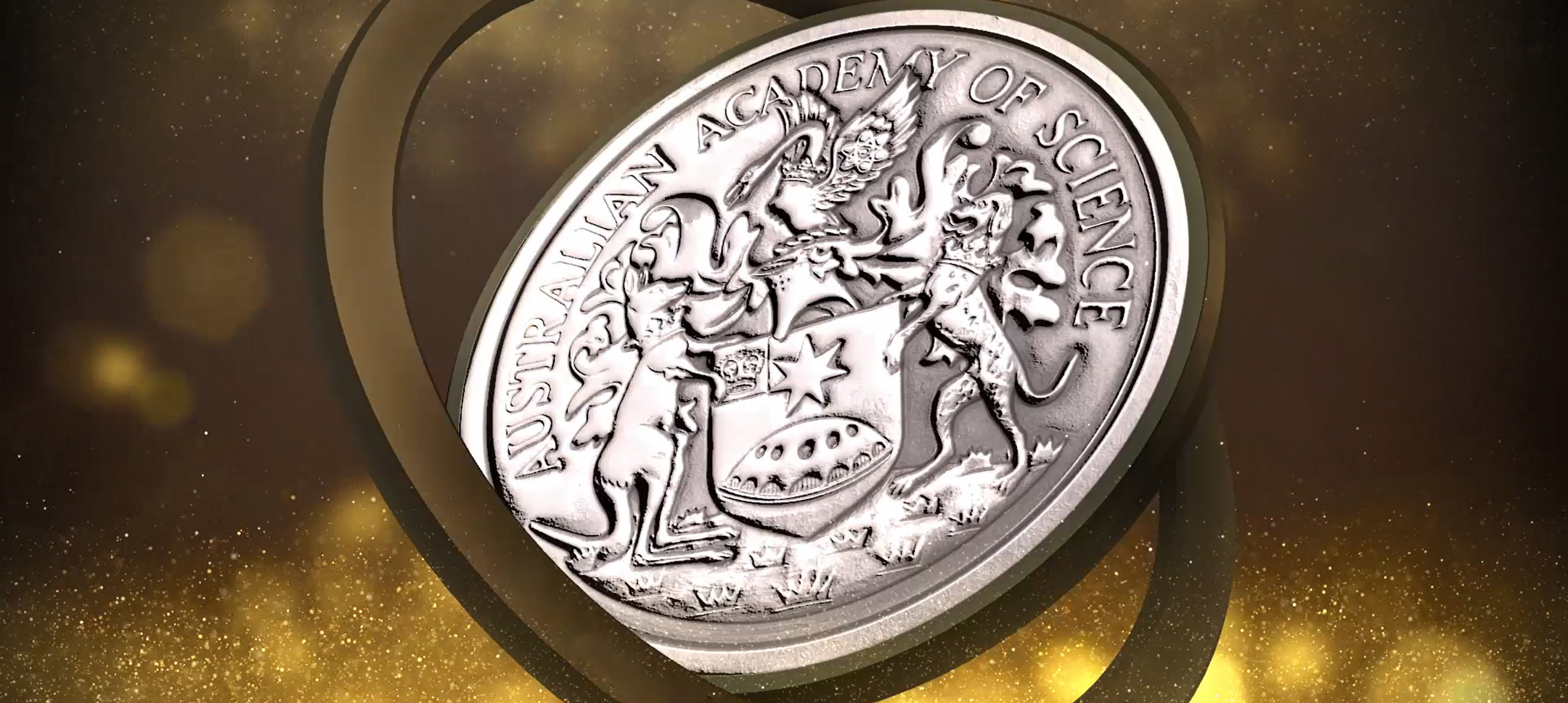



Frederick White Medal


Award highlights
- The award recognises the achievements of scientists in Australia who are engaged in research of intrinsic scientific merit that has made an actual or potential contribution to community interests, to rural or industrial progress, or to the understanding of natural phenomena that have an impact on the lives of people.
- Relevant areas of research are physics, astronomy, chemistry, and the terrestrial and planetary sciences.
- This award honors the contributions to Australian science of the late Sir Frederick White KBE FAA FRS.
The Frederick White Medal honours the contributions to Australian science of the late Sir Frederick White KBE FAA FRS. It recognises the achievements of scientists in Australia who are engaged in research of intrinsic scientific merit that has made an actual or potential contribution to community interests, to rural or industrial progress, or to the understanding of natural phenomena that have an impact on the lives of people. Relevant areas of research are physics, astronomy, chemistry, and the terrestrial and planetary sciences. The Medal and an honorarium of up to $3000 (GST exempt) are awarded biennially to researchers up to 10 years post-PhD in the calendar year of nomination, except in the case of significant interruptions to a research career. Relevant research undertaken outside Australia may be considered, provided the researcher has conducted the majority of their research career—defined as periods of employment or study primarily involving research activities or research training—in Australia, and has been resident in Australia for at least the past two years.
This award is open to nominations for candidates from all genders. The Australian Academy of Science encourages nominations of female candidates and of candidates from a broad geographical distribution.
Candidates may be put forward for more than one award. If a proposed candidate is already the recipient of an Academy early-career honorific award, they will not be eligible for nomination for another early-career or mid-career honorific award. A mid-career honorific award recipient will also not be eligible for nomination for another mid-career honorific award. Fellows of the Academy are ineligible to be nominated for early and mid-career awards.
Key dates
Below are the key dates for the nomination process. While we aim to keep to this schedule, some dates may change depending on circumstances.
GUIDELINES
The following guidelines and FAQs provide important information about eligibility, submission requirements, and assessment processes. Please review them carefully before submitting a nomination.
How to nominate a scientist for the Academy’s honorific awards
The following guidelines contain detailed information for nominators.
These guidelines contain information for honorific award nominators.
The following guidelines contain information for honorific award referees.
These guidelines contain information for honorific award referees.
See below for specific relevant conferral dates for the current award round.
This document contains specific PhD conferral dates for early and mid-career honorific awards in the current award round.
Please submit your nominations using the Nominate button found on the top right of this webpage when nominations are open.
Please note the Academy uses a nomination platform that is external to the main Academy site. Nominators will be required to create an account on the platform. Even if you are familiar with the nomination process, please allow extra time to familiarise yourself with the platform.
Early-career, mid-career and career medals
Can I nominate myself?
- No – you must be nominated by someone else. Self-nominations are not accepted.
Can I submit a nomination on behalf of someone else?
- Yes – you can submit a nomination on behalf of someone else if you are not the nominator. An example would be a university grants office or personal/executive assistant completing the online nomination form on behalf of a nominator. Once the form is submitted, the nominator will be sent an email confirming that the nomination has been completed. If a nominee submits a nomination for themselves on behalf of a nominator it will not be considered a self-nomination.
Residency requirements
- Winners of all awards except the Haddon Forrester King Medal should be mainly resident in Australia and/or have a substantive position in Australia at the time of the nomination deadline. Unless explicitly stated in the awarding conditions, the research being put forward for the award should have been undertaken mainly in Australia. Some awards have more specific conditions that the relevant selection committee must apply and nominators are advised to read the conditions associated with each award very carefully.
Honorific career eligibility (more specific details found in the honorific awards nominator guidelines and the honorific award post PhD eligibility guidelines)
- Career eligibility is calculated by calendar year.
- Early career awards are open to researchers up to 10 years post-PhD.*
- Mid-career awards are open to researchers between eight and 15 years post-PhD.*
- Please note that the Awards Committee may consider nominees with post PhD dates outside of these ranges if a career exemption request is being submitted with the nomination, further guidelines on career exemption requests can be found in the nomination guidelines.
- See the post-PhD eligibility guidelines document for relevant conferral dates.
- * or equivalent first higher degree e.g. D.Phil., D.Psych., D.Sc.
Academy fellowship requirements in award nominations
- Fellows and non-Fellows of the Academy can provide nominations for either Fellows or non-Fellows for all awards.
Women only awards
- The Dorothy Hill, Nancy Millis and Ruby Payne-Scott Medals are for women only. These medals are open to nominees who self-identify as a woman in the award nomination form. The Academy does not require any statement beyond a nominee’s self-identification in the nomination form.
- This practice is consistent with the Sex Discrimination Act 1984, which has recognised the non-binary nature of gender identity since 2013, and gives effect to Australia’s international human rights obligations. The Academy remains committed to the fundamental human rights principles of equality, freedom from discrimination and harassment, and privacy, as well as the prevention of discrimination on the basis of sex and gender identity.
PREVIOUS AWARDEES
Dr Adele Morrison, Australian National University
Dr Adele Morrison studies how our changing climate will affect the Southern Ocean and Antarctica. She uses her knowledge of ocean physics, combined with supercomputers, to develop models and make projections of this critically important region. Dr Morrison's work has involved predicting how ocean circulation will respond to climate change, including the consequences of oceanic changes for the global carbon cycle and Southern Ocean ecosystems.
She also studies how the coastal waters around Antarctica will be altered under future climate scenarios, which has implications for the future of the Antarctic Ice Sheet, and the consequent rate of global sea level rise. Dr Morrison has made a substantial contribution to the development of Australia's capability to model Antarctic oceanography and is a leader of the Australian ocean-sea ice modelling community.
Dr Hamish Clarke, University of Melbourne
Wildfires are part of life. Not just in Australia, but all over the world. If we’re going to live with fire, we’d better get to know it. This is according to Dr Hamish Clarke, who studies climate change effects on bushfire risk: how a warming world changes the chances of fire-related threats being realised. His research ranges from the drivers of fire (think fuel, dryness, weather and ignitions), to impacts on people, property and the environment, to prescribed burning. For Dr Clarke, science is half the puzzle – the other half is working closely with fire managers and the community, to understand their values and work to get everyone on the same page. His research shows that the increasing fire weather conditions we currently see could be a prelude to something much worse without strong climate change action. It is also paving a path to quantitative, risk-based approaches to fire management.
Professor Kerrylee Rogers, University of Wollongong
Professor Kerrylee Rogers has made an internationally significant contribution to one of the most pressing environmental issues of our time: the impact of climate change on the world’s most threatened and ecologically important habitat, wetlands. Her work has demonstrated that coastal wetlands (mangrove and saltmarsh) respond dynamically to sea-level rise. By trapping sediment and building root systems, wetlands adapt to climate change but also help mitigate climate change by sequestering atmospheric carbon dioxide. Professor Rogers has used these insights to show that the restoration of coastal wetlands is an effective climate change adaptation strategy that can yield financial benefits to landholders. Carbon captured through wetland restoration can be reported by governments as saved emissions and traded by landholders in emissions trading programs. These insights have been effectively communicated through management and policy-focused papers, presentations and expert advice.
Professor Madhu Bhaskaran, RMIT University
Professor Madhu Bhaskaran is transforming how we imagine, use, and interact with electronic devices. Professor Bhaskaran’s signature advance is in the field of stretchable electronics where she has developed techniques to stretch devices to an unprecedented level – allowing them to be worn on the skin. This has realised a range of visionary applications, such as skin-worn sensors that alert miners to dangerous gas levels, or warn civilians about harmful UV levels. Professor Bhaskaran is currently working with industry partners to bring these sensors out from the laboratory into everyday life. These are in the form of sensors in bedding products for aged care which would non-invasively track presence and biometrics of aged people during night.
Dr Alex Sen Gupta, The University of New South Wales Sydney
Dr Alex Sen Gupta is one of Australia’s foremost experts in large‐scale climate variability and change with a particular focus on the Southern Hemisphere ocean and atmosphere. His work spans a large array of areas and has led to a greater understanding of large‐scale climate variability and change. His world‐class research achievements have provided new insights into improving seasonal forecasts; identifying and correcting errors in modern climate models, improving climate projections, and improving our understanding of how physical changes to our oceans affect marine biology and important fisheries.
2016
Associate Professor Michael James Ireland, Australian National University
Associate Professor Ireland develops and applies the latest optical and infrared technologies to build innovative astronomical instruments to probe the lifecycles of stars and planets. A central aim of his research has been to develop instrumentation and techniques capable of finding out how planets form and evolve. One example of this research has been the discovery of the first planet orbiting another star to be caught in the process of formation. He has also shown, both from theory and from observations using innovative astronomical instruments, just how dying solar-type stars shed their outer layers in a wind of molecules and tiny transparent dust grains. He is currently building innovative astronomical instrumentation for detecting planets around other stars, both for Australian telescopes and the largest international telescopes.
2014
Professor Christian S M Turney, University of New South Wales
Professor Turney is an internationally recognised earth scientist and research leader in both climate and environmental change, from the tropics to the poles. By pioneering new ways of combining climate models with records of past climate change (spanning from hundreds to thousands of years), he has discovered new links between variability mechanisms in the Australian region and global climate change.
2012
Dr Andrew Hogg, Australian National University
Dr Andrew Hogg uses models of ocean circulation to understand the role of oceans in climate. He has discovered new ways in which the ocean can generate low frequency climate variability, and has applied this knowledge to the prediction of the ocean’s response to climate change. He has demonstrated the importance of resolving small-scale circulation features, particularly in the Southern Ocean region, pointing the way forward for the next generation of climate models.
2010
Dr Amanda Barnard, CSIRO Materials Science and Engineering
Using Australia’s largest supercomputer, Amanda Barnard studies the possible toxicology and environmental impact of nanoparticles, only millionths of a millimetre in size, by predicting how nanoscale materials could react in different environments. This enables the selection of nanomaterials from the large number currently being produced that are likely to be safest, both for people and the environment, and mitigating the risk of harmful combinations.
2008
Dr Ronald Smernik, The University of Adelaide
Ronald Smernik has made a significant impact on the chemistry of organic materials in soils and sediments. His work focuses on the development and application of innovative and sophisticated nuclear magnetic resonance (NMR) techniques to characterise soil properties. His research has increased understanding of soil processes and their significance in global carbon cycling, and has important applications in soil management for sustainable agriculture.
2006
Dr James Tickner, CSIRO
James Tickner has made impressive scientific contributions in innovation and has secured six patents. He developed nuclear instrumentation for the mineral industry and invented a new type of camera for finding buried landmines. He co-invented the concept of fast-neutron/gamma ray radiography for rapidly screening bulk cargo. He has made important advances in the fields of nuclear simulation and solving challenging measurement or imaging problems.
2004—M. H. England
2002—L. D. Rotstayn
2000—P. J. Scales
1998—G. I. McFadden
1996—I. E. Woodrow
1994—R.T. Kingsford
1992—M.B. Singh
1990—D.J. Evans
1988—T.J. McDougall
1986—L.R. White
1984—P.M. Colman