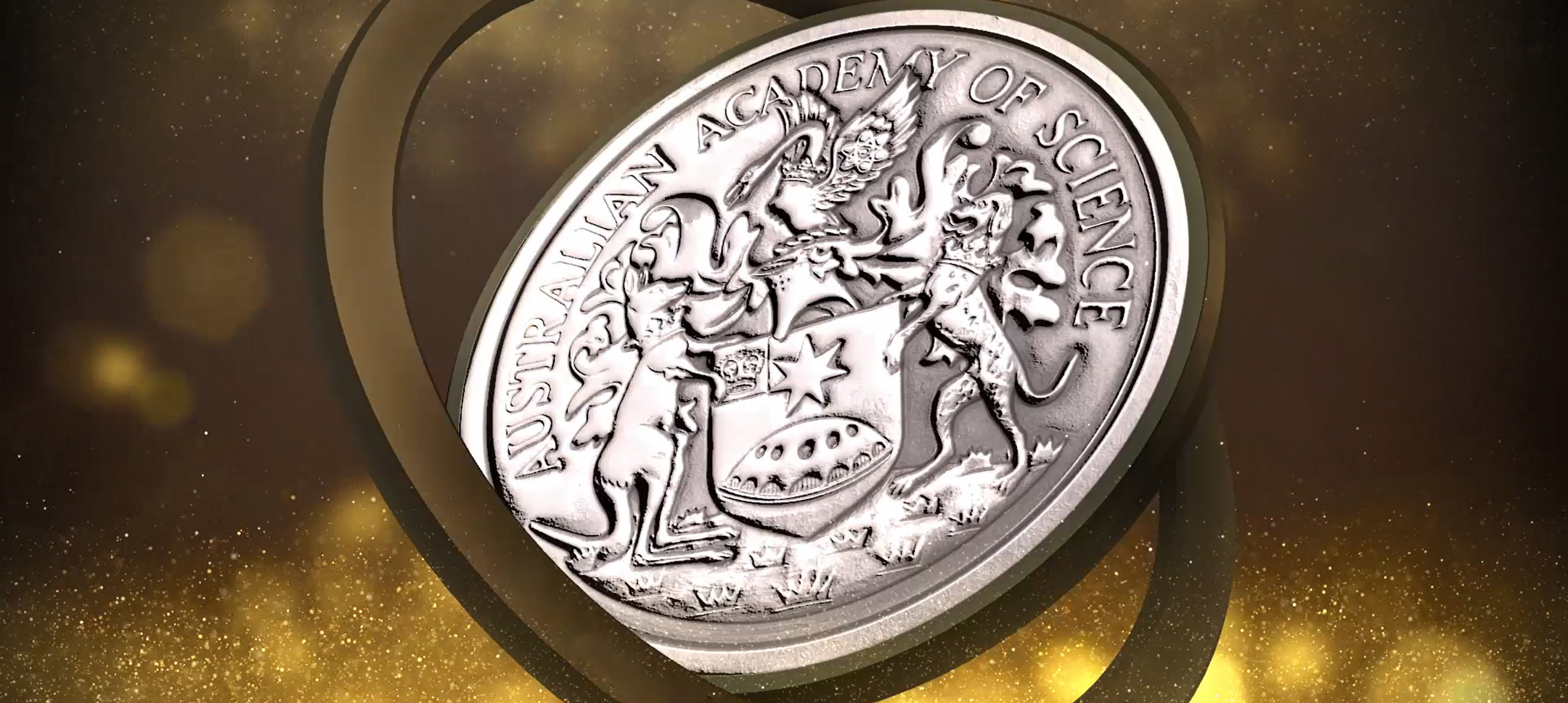



Ian Wark Medal and Lecture
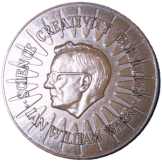

Award highlights
- The award recognises research that contributes to the prosperity of Australia where that prosperity is attained through the advancement of scientific knowledge or its application, or both.
- This award commemorates the contributions to Australian science and industry by the late Sir Ian William Wark CMG CBE FAA FTSE.
- The Medal and a lecture is presented at a dinner in the awardee's state capital.
The Ian Wark Medal and Lecture commemorates the contributions to Australian science and industry by the late Sir Ian William Wark CMG CBE FAA FTSE.
The award recognises research that contributes to the prosperity of Australia where that prosperity is attained through the advancement of scientific knowledge or its application, or both. The award is normally made every two years and includes a $3,000 honorarium. The Medal and a lecture is presented at a dinner in the awardee's state capital.
The Australian Academy of Science encourages nominations of female candidates and of candidates from a broad geographical distribution.
Candidates may be put forward for more than one award. If a proposed candidate is already the recipient of an Academy award, the second award must be for a distinct, additional, body of work undertaken since the first award, and/or work in a different field.
Key dates
Below are the key dates for the nomination process. While we aim to keep to this schedule, some dates may change depending on circumstances.
GUIDELINES
The following guidelines and FAQs provide important information about eligibility, submission requirements, and assessment processes. Please review them carefully before submitting a nomination.
How to nominate a scientist for the Academy’s honorific awards
The following guidelines contain detailed information for nominators.
These guidelines contain information for honorific award nominators.
The following guidelines contain information for honorific award referees.
These guidelines contain information for honorific award referees.
Please submit your nominations using the Nominate button found on the top right of this webpage when nominations are open.
Please note the Academy uses a nomination platform that is external to the main Academy site. Nominators will be required to create an account on the platform. Even if you are familiar with the nomination process, please allow extra time to familiarise yourself with the platform.
Early-career, mid-career and career medals
Can I nominate myself?
- No – you must be nominated by someone else. Self-nominations are not accepted.
Can I submit a nomination on behalf of someone else?
- Yes – you can submit a nomination on behalf of someone else if you are not the nominator. An example would be a university grants office or personal/executive assistant completing the online nomination form on behalf of a nominator. Once the form is submitted, the nominator will be sent an email confirming that the nomination has been completed. If a nominee submits a nomination for themselves on behalf of a nominator it will not be considered a self-nomination.
Residency requirements
- Winners of all awards except the Haddon Forrester King Medal should be mainly resident in Australia and/or have a substantive position in Australia at the time of the nomination deadline. Unless explicitly stated in the awarding conditions, the research being put forward for the award should have been undertaken mainly in Australia. Some awards have more specific conditions that the relevant selection committee must apply and nominators are advised to read the conditions associated with each award very carefully.
Honorific career eligibility (more specific details found in the honorific awards nominator guidelines and the honorific award post PhD eligibility guidelines)
- Career eligibility is calculated by calendar year.
- Early career awards are open to researchers up to 10 years post-PhD.*
- Mid-career awards are open to researchers between eight and 15 years post-PhD.*
- Please note that the Awards Committee may consider nominees with post PhD dates outside of these ranges if a career exemption request is being submitted with the nomination, further guidelines on career exemption requests can be found in the nomination guidelines.
- See the post-PhD eligibility guidelines document for relevant conferral dates.
- * or equivalent first higher degree e.g. D.Phil., D.Psych., D.Sc.
Academy fellowship requirements in award nominations
- Fellows and non-Fellows of the Academy can provide nominations for either Fellows or non-Fellows for all awards.
Women only awards
- The Dorothy Hill, Nancy Millis and Ruby Payne-Scott Medals are for women only. These medals are open to nominees who self-identify as a woman in the award nomination form. The Academy does not require any statement beyond a nominee’s self-identification in the nomination form.
- This practice is consistent with the Sex Discrimination Act 1984, which has recognised the non-binary nature of gender identity since 2013, and gives effect to Australia’s international human rights obligations. The Academy remains committed to the fundamental human rights principles of equality, freedom from discrimination and harassment, and privacy, as well as the prevention of discrimination on the basis of sex and gender identity.
PREVIOUS AWARDEES
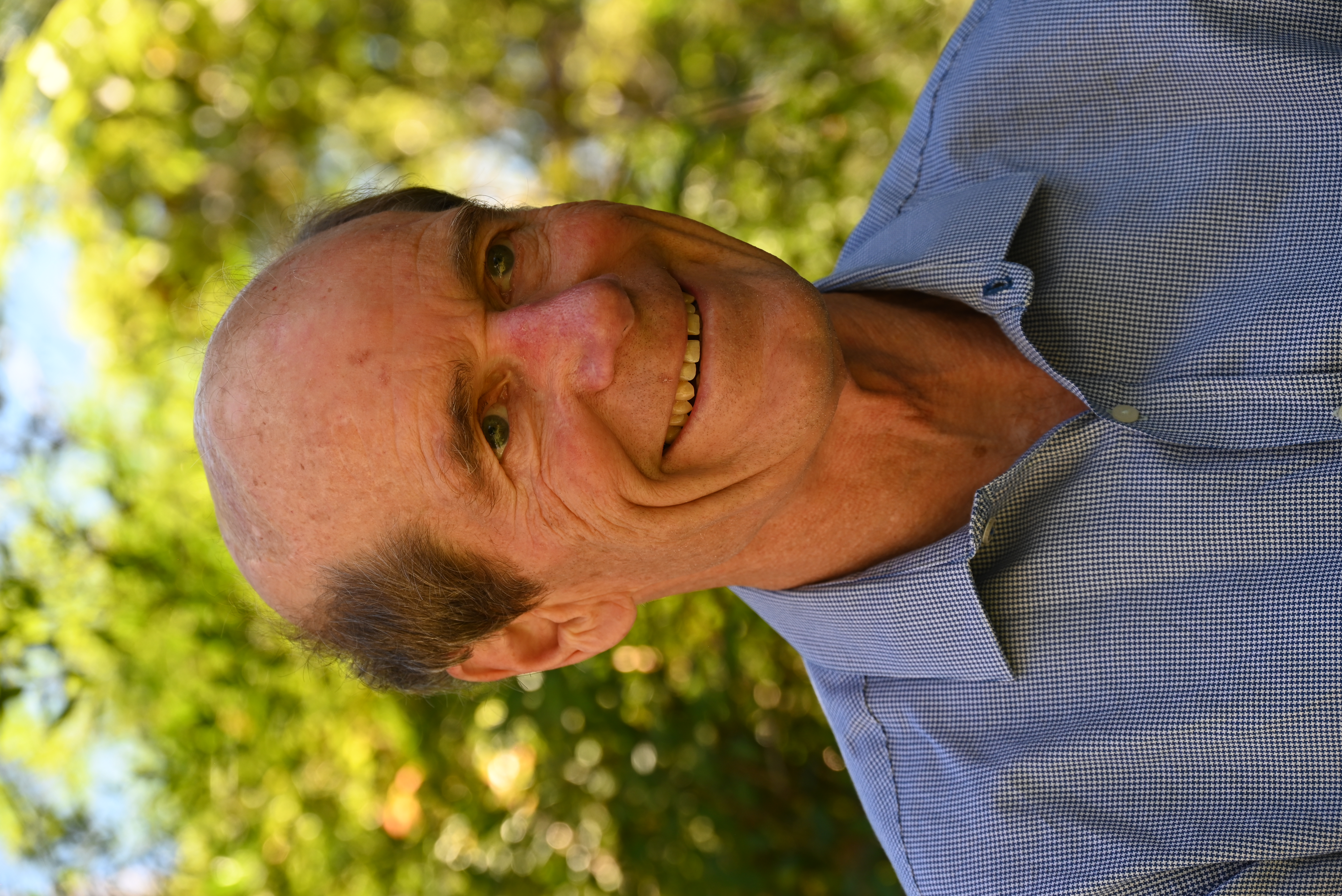
Dr Anthony Murphy, CSIRO
Dr Tony Murphy’s world-leading thermal plasma research has had extensive scientific, industrial and environmental impact. Thermal plasmas are high-temperature arc plasmas used in applications such as welding, plasma spraying, and waste destruction. The approaches developed by Dr Murphy have made critical contributions to the accurate computational simulation of thermal plasmas of practical interest. His computational models were instrumental in ensuring that the PLASCON plasma waste destruction process could be applied to ozone-depleting substances; the process has since destroyed international stockpiles of these gases.
He led the understanding of the critical influence of metal vapour in arc welding, allowing him to develop arc welding simulation software of unprecedented accuracy, which has been transferred to the automotive and rail industries. His plasma property data are used by researchers and industry in more than 25 countries to design aircraft and high-voltage switchgear and to improve welding and cutting processes and arc lamps.
Professor Anthony Weiss AM FTSE, University of Sydney
Professor Anthony Weiss is the international leader on studies and applications of the key human elastic protein needed for resilience and recoil in skin and blood vessels. His scientific innovations have facilitated its commercial translation in one of Australia’s largest healthcare transactions. Professor Weiss’s scientific leadership has defined tropoelastin’s shape, elucidated how cells respond to tropoelastin through specific molecules called integrins and their binding mechanisms, defined how to modulate self-assembly, and articulated the rules governing this assembly process. He has created intricate elastic architectures tailored to specific biomedical applications that orchestrate cell growth and enhance tissue repair.
Professor Tim Senden, Australian National University
Professor Tim Senden is a physical chemist whose pioneering research has provided new understanding of surface phenomena at the nanoscale, developing methods to quantify colloidal and molecular forces. For two decades, he was involved in the development of novel applications of radioactive nanoparticles for clinical use, which received strong commercial sponsorship leading to clinical trials. From the 2000s, Professor Senden was part of a major translational activity that continues to develop a novel imaging and analysis platform based on X-ray microtomography, leading to new insights into complex granular and porous materials. This activity has greatly enhanced applications in topics spanning papermaking, carbon sequestration, composites, and mineral and hydrocarbon extraction. Following an industry consortium of 23 energy companies, Lithicon was spun-off and became one of the most successful ANU companies.
Professor Calum Drummond FTSE, RMIT University
Professor Calum Drummond has made outstanding contributions to advancing the fundamental understanding of the key factors governing molecular assembly, and particle and surface interactions in liquids. A hallmark of his research has been the use of sophisticated high-throughput preparation and characterisation techniques to fast track the creation of materials, and the determination of the structure and properties of materials, at the nanoscale. This fundamental research in chemistry has enabled the development and commercialisation of advanced high-performance materials for economic and societal benefit. The materials have been applied in diverse areas including energy storage, medical therapy and diagnosis, household consumer and industrial large-scale uses.
2016
Scientia Professor Martin Green AM FAA FRS FTSE, UNSW
Professor Green is an acknowledged world‐leader in field of photovoltaics. He has published extensively and influentially, made many highly significant contributions to the knowledge base of the field, and successfully established a world‐class research hub that is responsive to Australian needs in the photovoltaics industry. Several generations of his group’s technology have been successfully commercialised including, most recently, the Passivated Emitter and Rear Cell (PERC) that produced the first 25% efficient silicon cell in 2008 and accounted for the largest share of new manufacturing capacity added worldwide in 2014. His fundamental and applied research has led to, and will continue to lead to significant economic benefits both in Australia and worldwide.
2014
Professor Min Gu FAA, Swinburne University of Technology
Modern technology has supported the growth and prosperity of global economies but it presents significant challenges including the information explosion, energy security and provision of cost-effective healthcare. Since it relies on light rather than electronic signals, photonics can help meet many of these challenges. As a pioneer in photonics at the nanoscale, Professor Min Gu has developed green nanophotonic innovations which have significant benefits including low energy consumption big data centres, early cancer detection and environmentally-friendly solar cells.
2012
Professor Kevin Galvin, University of Newcastle
Professor Galvin is the inventor of a new technology, the Reflux Classifier, which is having very significant industrial impact in gravity separation, beneficiating fine coal and dense minerals. The Reflux Classifier consists of a novel fluidized bed incorporating a system of parallel inclined channels. With closely spaced inclined channels, shear induced inertial lift conveys the relatively low density particles with the fluid flow, while the denser particles sediment, sliding down the inclined surfaces.
Professor Galvin developed a major R&D collaboration with Ludowici Australia over a 10 year period, producing a definitive description of the complex physical processes involved in the separations, and basis for applying the technology in the design of a broad range of applications. He is the Director of the Centre for Advanced Particle Processing and Transport and is well known in both the academic and industrial worlds for his outstanding contributions to his field, gravity separation.
2010
Professor Aibing Yu, University of New South Wales
Aibing Yu is an authority in the areas of particle packing, particulate and multiphase processing, as well as simulation and modelling. His research in the field of particle or powder technology, and the modelling of particulate systems, has greatly expanded the scientific knowledge base and has been extensively applied. His work has led to significant economic benefits in mineral, metallurgical, chemical and material industries, most notably steel and coal.
2008
Dr Alan Reid, Former Director of CSIRO Institute of Energy and Earth Resources
Alan Reid has achieved international recognition in the areas of complex chemistry relating to mineral processing, the solid state chemistry for solar collector systems and in the statistics and stereology of mineral particle systems. His research has contributed significantly to Australia's prosperity through the creation of a solar energy absorber surface, AMCRO, which is widely used in Australia's solar panel industry, and also in the development of an automated mineral analysis system, QEMSCAN, which has had major financial benefits for mining companies internationally.
2006
Professor Graeme Clark AC, University of Melbourne.
Graeme Clark is internationally recognised for inventing the Bionic Ear, the first multiple channel cochlear Implant. His pioneering research on electrical stimulation of the auditory pathways led to the development of the prototype multiple-channel cochlear implant which was implanted in a research volunteer in 1978. Since then, the implant has brought hearing to more than 50,000 deaf people, including 20,000 children, in over 120 countries. He founded The Bionic Ear Institute in 1983 and continues to refine the implant so that patients now understand significantly more speech, and severely and profoundly deaf children can develop near-normal speech.
2003—G.J. Jameson
2001—K.G. McCracken
1998—T.W. Healy
1996—R. Woodall
1994—H.K. Worner
1991—W.J. Trahar
1989—D.H. Solomon
1987—A.L.G. Rees