
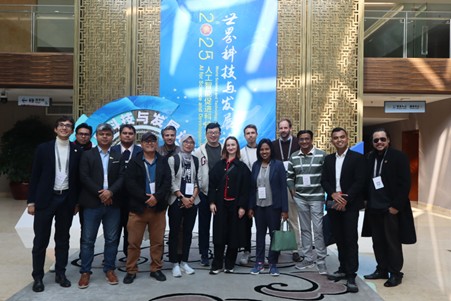
In October 2025, I had the privilege of representing the Australian Academy of Science at the Next-Generation Science Diplomacy workshop in Beijing, China.
The workshop was organised and sponsored by the International Science Council (ISC), for which the Australian Academy of Science serves as the Regional Focal Point for Asia and the Pacific.
It was held alongside the 2025 World Science and Technology Development Forum, hosted by the Chinese Association for Science and Technology (CAST), which was the main sponsor of the event and generously provided accommodation at the forum venue.
Over three days, the workshop created a rare and valuable space for 11 representatives of early- and mid-career researcher (EMCR) organisations from across the Asia–Pacific region to meet, reconnect, and exchange experiences on and map out the EMCR situation.
Participants came from India, New Zealand, Nepal, Malaysia, Bangladesh, Sri Lanka, Pakistan, Japan, Indonesia, and Australia, representing a diverse range of national young academies and EMCR forums.
Despite very different national contexts, the shared challenges and aspirations were strikingly similar, particularly around representation, visibility, and the sustainability of EMCR-led initiatives.
The forum commenced with welcoming remarks from senior leadership across CAST and the ISC, alongside welcome video messages from President Xi Jinping.
The broader World Science and Technology Development Forum featured presentations from leading researchers showcasing major technological advances, including developments in hydrogen storage, future mobility, and emerging artificial intelligence algorithms with relevance to quantum technologies.
This context provided a powerful reminder of how closely scientific progress, national priorities, and international collaboration are intertwined.
The workshop focused on the practical dimensions of science diplomacy, combining high-level panel discussions with an applied negotiation simulation.
A central component was the hypothetical Coralesia Biodiversity Agreement case study, which explored how scientific evidence, Indigenous knowledge, policy priorities, and international diplomacy intersect in complex decision-making environments, aspects that are directly relevant to Australia.
Through facilitated group negotiations, participants gained hands-on experience in balancing environmental sustainability, economic development, and cultural rights – highlighting the value of inclusive, evidence-informed diplomacy.
Linking the science diplomacy workshop with a global science and technology forum was a deliberate and strategic choice by the ISC.
In a period marked by increasing geopolitical tension, trade disputes, and intellectual property concerns, the workshop emphasised that international cooperation is rarely linear or simple, but instead layered, negotiated, and deeply dependent on trust and mutual understanding.
Beyond the formal program, informal interactions were equally valuable.
During the dinner, EMCR delegates discussed the structure and governance of their respective organisations, approaches to increasing participation, and strategies for maintaining momentum in largely volunteer-driven communities.
A recurring theme was the growing expectation placed on EMCRs to contribute service, advocacy, and leadership, often without corresponding recognition or institutional reward.
In this context, the level of structural support provided by the Australian Academy of Science to its EMCR Forum was frequently noted as outstanding, but essential for a less densely populated country.
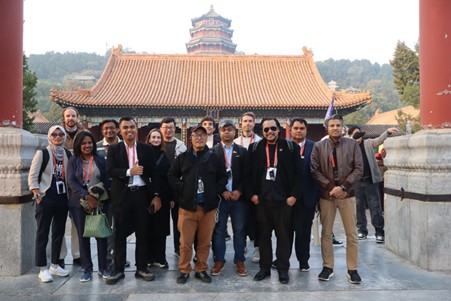
Social networking activities continued on the second day with a visit to the Summer Palace in northwest Beijing. This shared experience offered not only an opportunity to connect informally, but also a meaningful engagement with China’s history and cultural heritage.
For many delegates, it reinforced the broader message of the workshop: that science diplomacy is ultimately about people, relationships, and understanding context – not only policies or institutions.
Reflecting on the discussions from an EMCR perspective, it became increasingly clear that while national and international science systems are beginning to recognise the value of EMCR voices, meaningful inclusion remains inconsistent.
Support for EMCR engagement is often ranked low on institutional agendas, particularly within universities facing competing priorities. Improving this situation requires sustained advocacy, strong networks, and continued participation at national and international levels.
EMCR organisations, including the Australian EMCR Forum, operate as bottom-up, volunteer-led communities with limited resources, and must therefore make careful and strategic choices about where to focus their efforts.
The workshop also highlighted the unique role of the ISC in this landscape.
The ISC was formed in 2018 through the merger of the International Council for Science (ICSU), founded in 1931, and the International Social Science Council (ISSC), founded in 1952.
This merger brought together long-standing traditions in both the natural and social sciences, creating a single global organisation dedicated to advancing science as a public good.
Since its formation, the ISC has increasingly recognised the importance of engaging EMCRs – not simply as future leaders, but as essential contributors to contemporary science-policy dialogue.
I would like to extend special thanks to the Chinese Association for Science and Technology (CAST) for providing a dedicated grant that enabled the participation of EMCR delegates from across the Asia–Pacific region. This support was critical in ensuring that early- and mid-career researchers were able to engage meaningfully in the workshop and associated discussions.
I also wish to sincerely acknowledge Gabriela Ivan, who served as the main organiser of the workshop, and Nicola Ragazzi, who co-organised the event. Their professionalism, commitment, and attention to detail were central to the success of the workshop.
Finally, I thank the Australian Academy of Science for its continued support of my participation and for its strong and sustained commitment to representing EMCR perspectives at national and international levels.

Dr Marcus Korb is a chemist at the University of Western Australia. He has served as an Executive Committee member of the Australian Academy of Science EMCR Forum since 2024, where he currently leads the Forum’s Australian Research Council (ARC) portfolio. He also initiated the EMCR Survey, scheduled for publication in early 2026.
Marcus highly values the opportunities the EMCR Forum has created for collaboration with fellow EMCRs, Academy staff, and Fellows, and for raising awareness of EMCR perspectives that shape science dialogue and research systems at local, national, and increasingly international levels.
© 2026 Australian Academy of Science
